"Pain-Free Knees."
"Pain-Free Knees."
🛡️ Verabschieden Sie sich von Bone-On-Bone
⚖️ Stabile Kniestabilität
🚫 Sofortige Schmerzlinderung
🏃 Bewegen Sie sich mit Zuversicht
PAKET BUCHEN & SPAREN
Verfügbarkeit für Abholungen konnte nicht geladen werden
Kaufen Sie ein Paket und erhalten Sie 25 % Rabatt

FITNESS-KNIESCHÜTZER

"Pain-Free Knees."
ROOT CAUSE
It's Not One Bad Step. It's Years Of Them.
Most people blame one moment for their knee pain: a twist, a fall, a bad step off a curb.
The truth is the damage started long before that.
Your knees carry your full body weight every day, through every step, every stair and every time you stand up from a chair. They work like your car's shock absorbers. Drive on rough roads long enough without maintenance and the shock absorbers wear out.
Your knees work the same way. Years of repetitive movement, poor posture and daily strain slowly wear down the cartilage that cushions the joint. As it thins, the space inside the joint shrinks, and the bones start to rub against each other.
That's the grinding, the swelling and the stiffness you feel. That's what "bone-on-bone" means.

WHY IT KEEPS HURTING
Why Pills, Braces & Creams Wear Off By Dinnertime
When the joint space shrinks, three things happen around your knee at once:
- Pressure builds on the joint every time you move.
- Blood flow slows to the area, so less oxygen and fewer nutrients reach it.
- The muscles around the knee tighten and stiffen to protect it. The muscles weaken over time, and the joint gets even less support.
Each of these feeds the others. That's why the pain keeps coming back.
Most remedies only touch one of the three, if any. Pain pills numb it for a few hours. A brace holds it but doesn't loosen it. Creams sit on the skin. They give temporary relief, and none of them works on what's happening around the joint.
The usual advice is "stretch it" or "rest it." Stretching is hard to do when your knee is already throbbing. Resting doesn't loosen anything. If either one worked, you wouldn't still be reading this.
No single therapy can target every part of the problem. That's why your knee needs three.

3 Therapies. 1 Knee. 15 Minutes.
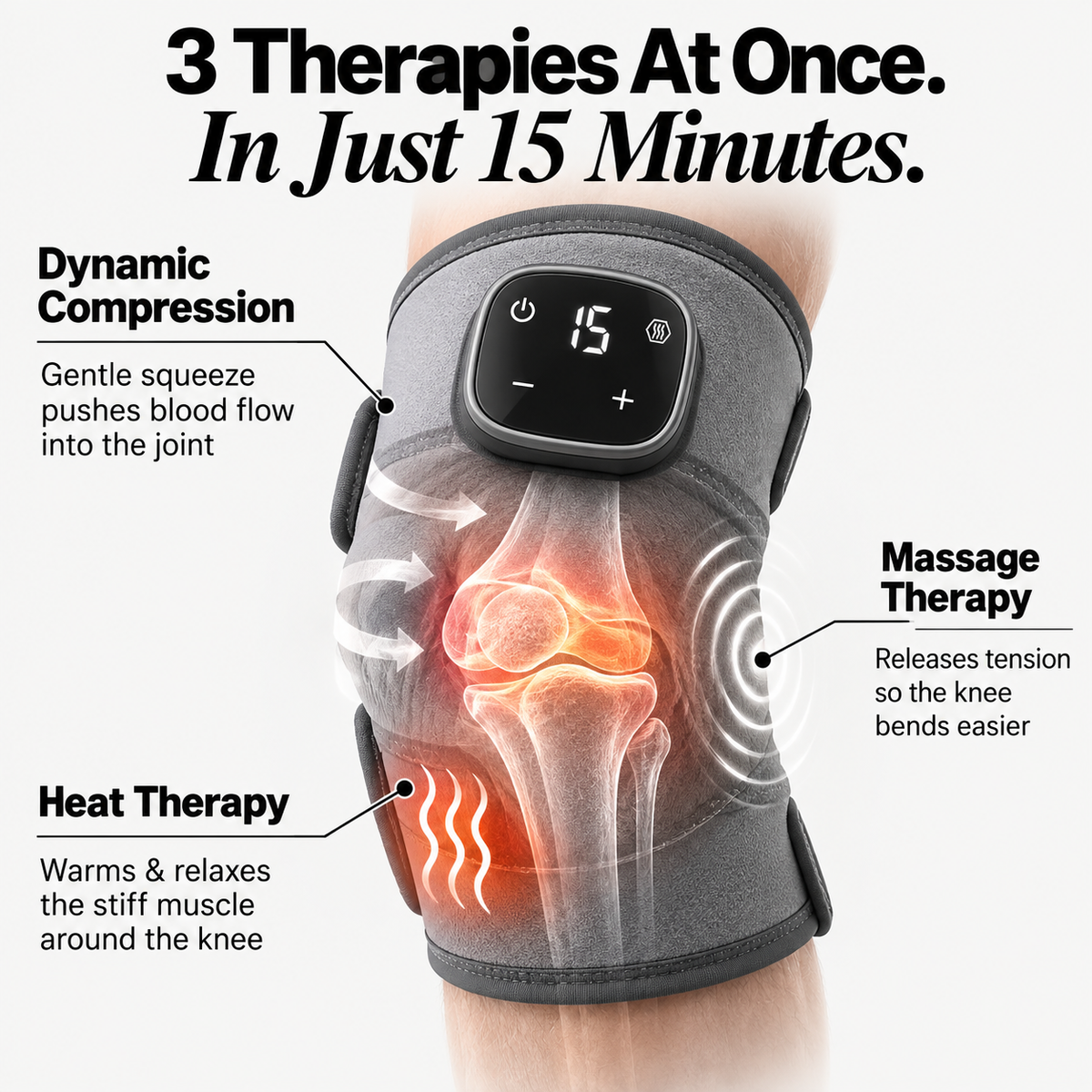
The Triple Method Knee Massager combines three therapies and runs them at the same time, so they work on the pressure, the blood flow and the stiff muscle together.
Dynamic Compression: Brings Blood Flow Back Air pressure squeezes and releases around the knee, adjusting to the right level automatically. This pumping action stimulates circulation, bringing oxygen and nutrients to the area and helping ease swelling around the joint.
Heat Therapy: Loosens The Stiffness Gentle, soothing warmth sinks into the knee, relaxing the tight muscles and tendons around the joint so they become more flexible and less prone to aching.
Massage Therapy: Releases The Tension Vibration massage works the muscles, tendons and ligaments around your knee, releasing tension and helping improve range of motion so the knee bends more easily.
Done separately, each one helps a little. Done together, they work on the whole problem at once.
How to use it: Wrap it around your knee, press a button to choose your mode and intensity, then sit back for 15 minutes. You don't need to stretch, exercise or go to a clinic.
- 3 compression levels and 3 massage modes
- Rechargeable and cordless, so you can use it on the couch, in bed or at your desk
- Adjustable straps fit most knees

WEEK-BY-WEEK: WHAT TO EXPECT
What 15 Minutes A Day Can Look Like
Day 1: The First Session The warmth sinks in and the compression starts to work. Some people find the first session uncomfortable because the knee is so tense. Start on the lowest setting. By the end of the 15 minutes, many people say the knee feels looser than it has in a while.
Week 1: Building The Habit Use it once in the morning and once in the evening. Mornings are usually where you notice it first. The first steps out of bed start to feel less stiff and less like you have to "warm up" the knee before walking.
Weeks 2–3: Moving With Less Thinking As the tight muscle loosens and circulation improves, everyday movements like standing up from a chair or getting in and out of the car start to take less effort. You stop bracing before every move.
Week 4: Stairs, Walks & Evenings The stairs at home stop being something you dread. Short walks feel more manageable. Evenings are calmer, and the 15-minute session before bed becomes part of your wind-down.
Weeks 6–12: Your New Routine By now it's a daily habit, like brushing your teeth. The goal isn't a "new knee." The goal is a knee that lets you get on with your day.
You have 90 days to decide. If it isn't helping, send it back for a full refund.